

Executive summary
From Strategic Alignment to Execution Reality
Organisations enter 2026 with strong alignment around internal transformation, particularly productivity improvement and AI adoption.
Strategic priorities and investment decisions point toward strengthening operating models, execution capability, and automation rather than relying primarily on external growth.
At the same time, confidence in achieving 2026 objectives remains moderate. This reflects pressure on leadership capacity and on organisations’ ability to absorb sustained transformation.
While AI features prominently across priorities and investments, maturity remains early-stage for most respondents, with activity concentrated in experimentation and pilots rather than enterprise-scale value creation.
Taken together, the survey highlights a clear pattern: the central challenge for 2026 is not strategic direction, but the ability to execute complex change with speed, accountability, and measurable results.
Productivity and AI dominate strategic priorities, signalling a shift toward internal execution capability
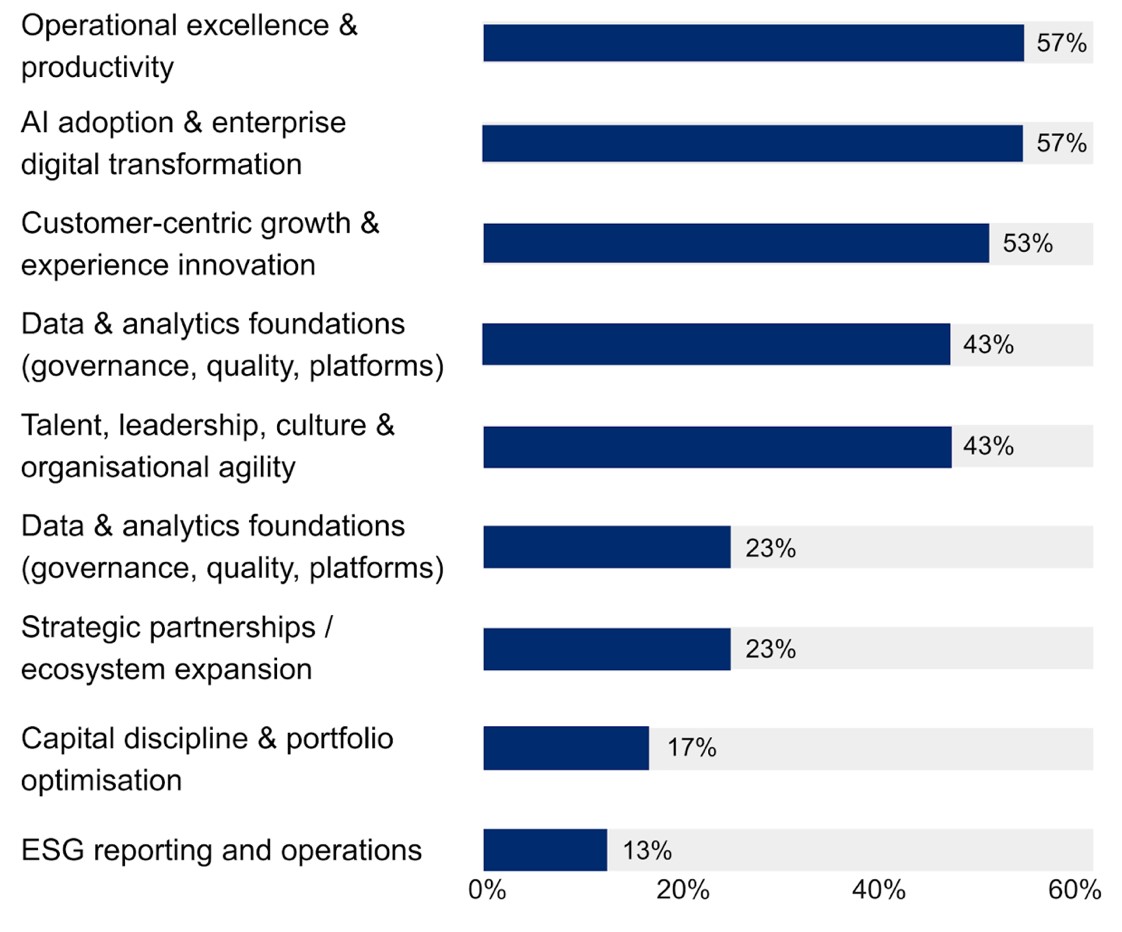
Across responses, productivity improvement and AI-driven enterprise transformation emerge as the most critical strategic priorities for 2026.
This indicates a broad pivot toward fixing the internal operating engine as the foundation for future performance.
Customer-centric growth remains important but is positioned behind operational excellence and execution effectiveness.
Data and analytics foundations and talent-related priorities are recognised as key enablers, while partnerships, capital optimisation, resilience, and ESG appear as secondary considerations for the year ahead, likely due to efforts deployed and progress made in previous years.
The prioritisation pattern suggests that organisations increasingly view growth as dependent on execution capability rather than strategy alone.
Which strategic priority is most critical for your organisation in 2026?
Investment allocation reinforces the focus on productivity-led transformation and operating model change
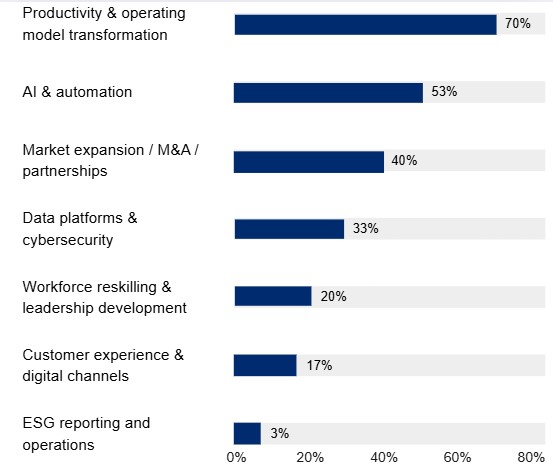
Investment intentions reinforce strategic priorities.
The largest share of incremental investment is directed toward productivity and operating model transformation, with AI and automation positioned as the primary accelerators.
Market expansion, M&A, and partnerships attract selective investment, indicating a disciplined approach to external growth.
Investment in workforce reskilling, leadership development, and customer experience is present but comparatively limited relative to the scale of transformation ambition.
ESG-related investment remains a lower near-term priority.
This alignment between priorities and capital allocation confirms that organisations recognise execution and transformation as the core performance levers for 2026.
Where will you increase investment most over the next 12 months?
Confidence levels indicate execution risk rather than uncertainty about strategic direction
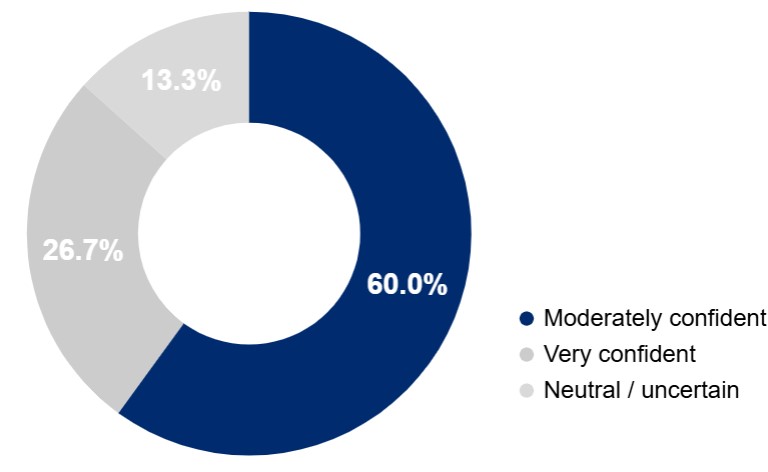
Most respondents describe themselves as moderately confident in achieving their 2026 objectives. A smaller group report high confidence, while a meaningful minority remain neutral or uncertain.
This distribution suggests that leaders broadly agree on what needs to be done but are less certain about their organisation’s capacity to deliver consistently, at pace, and across multiple initiatives.
The confidence profile points to execution risk rather than a lack of strategic clarity.
How confident are you in achieving your 2025 objectives?
Leadership capacity to manage disruption is the most frequently cited constraint on success
When asked about the single biggest leadership challenge for 2026, responses cluster strongly around the ability to manage change and disruption.
Leadership capability itself is cited almost as frequently, followed by challenges related to transformation execution, organisational agility, AI adoption, and external uncertainty.
Cost pressure and growth challenges are less prominent.
The responses indicate that leadership bandwidth, hands-on management capacity, and the ability to absorb multiple changes simultaneously are perceived as the primary constraints on delivery.
What is the single biggest leadership challenge you are navigating right now?
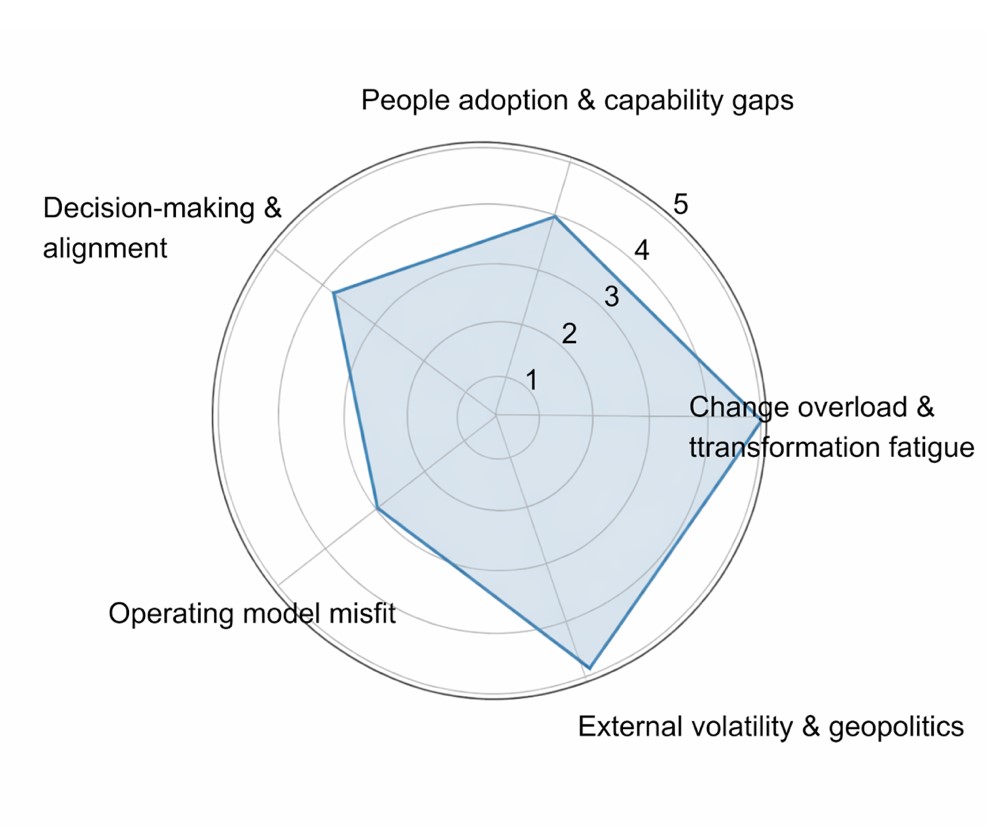
Note: The 1–5 scale reflects qualitative clustering of open-text responses and is directional rather than quantitative.
Open-text responses reinforce organisational strain as the dominant theme
Qualitative synthesis of open-text responses highlights recurring concerns around alignment, change management, middle-management capability, and the organisation’s ability to manage multiple transformations at once.
Several respondents explicitly reference challenges related to operating across regions, adapting to local market behaviours, and leading through uncertainty.
These themes reinforce the quantitative findings: execution pressure is concentrated at the leadership and organisational level rather than in strategy formulation or market opportunity.
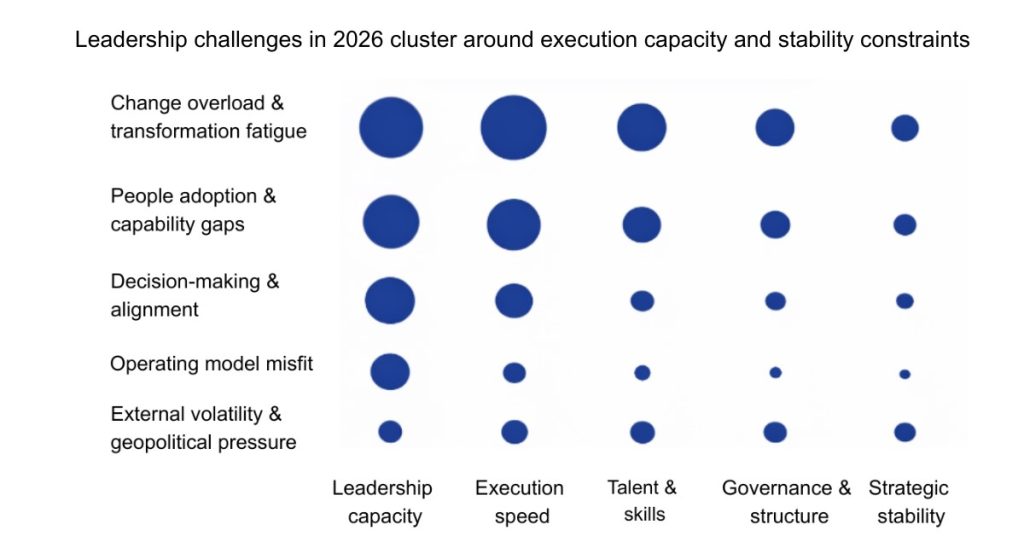
Note: Bubble size reflects relative emphasis of themes and should be interpreted directionally.
AI maturity remains early-stage, limiting enterprise-scale value creation
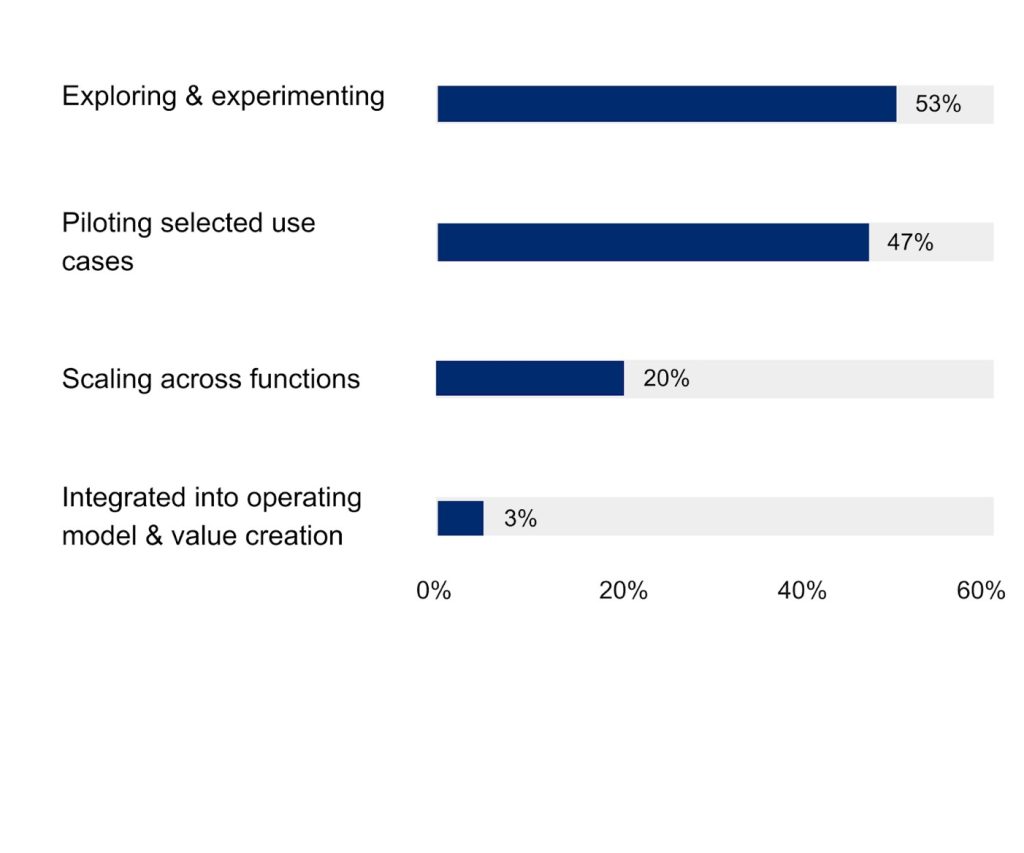
Although AI adoption features prominently in both strategic priorities and investment plans, maturity remains low across the sample.
Most organisations describe their AI efforts as exploring or experimenting, with a smaller number piloting selected use cases.
Only a very limited number report scaling AI across functions or integrating it into their operating model and value creation.
Open responses repeatedly reference adoption speed, data foundations, leadership understanding, and organisational readiness as constraints.
This indicates a persistent gap between AI ambition and realised impact.
How would you describe your organisation’s AI maturity?
Implications for 2026
Execution, accountability, and leadership capacity emerge as the critical enablers of results.
The survey consistently points to the same conclusion: organisations are clear on priorities and are committing capital accordingly, but delivery capacity is under strain.
The findings highlight the growing importance of execution-focused leadership, deep operational expertise, and mechanisms that support rapid integration, accountability, and measurable results.
In environments characterised by transformation, management transition, AI adoption, and operating model change, organisations increasingly require practical, hands-on leadership that can step in immediately, stabilise performance, and deliver strategic priorities.
Closing observation
In 2026, the differentiator will be the ability to turn complex plans into real business results.
The survey does not suggest a lack of ambition or intent. Instead, it highlights the limits of organisational capacity in the face of sustained transformation.
Performance in 2026 will depend less on the quality of strategy and more on the ability to execute, deliver, and sustain impact under pressure.
Recent Comments